
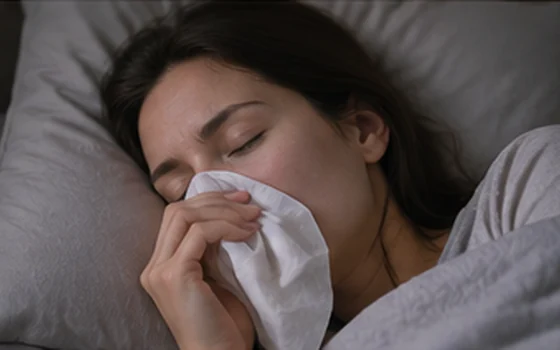
A sneeze heard at night does not establish that the person stayed asleep through it. Brief awakening may explain the observation, but published clinical explanations are not fully consistent about light sleep. It is better to acknowledge that uncertainty than claim a bedroom recording proves a particular sleep stage.
Why the usual yes-or-no answer is incomplete
Cleveland Clinic's dedicated explanation says a person wakes before sneezing, even if they do not notice the awakening. That is a useful way to interpret an apparent sleep sneeze.
However, its general sneezing reference allows for sneezing in early light sleep. These explanations differ. We cannot resolve that disagreement from observation alone, so this guide avoids an absolute claim about every sleep stage.
A recording does not identify the sleep stage
A video or audio clip can show when a sneeze occurred, but it does not provide the measurements used in a sleep laboratory. Closed eyes and a quick return to stillness are not proof that wakefulness never occurred.
The same caution applies to memory. Not remembering a short event is not enough to tell whether you were asleep throughout it. Consumer sleep-stage estimates also cannot settle the exact timing of a brief sneeze.
Look for a repeated trigger
Sneezing can follow irritation, allergies or an infection. Note whether it happens mainly in bed, after cleaning, around pets or during a period of congestion. That pattern can help you discuss the symptom with a clinician.
Do not assume the mattress is responsible simply because the sneeze happened nearby. Consider recent changes in detergents, fragrance use or the room, and avoid changing several things at once if you are trying to identify a practical trigger.
Make simple environmental checks
Keep bedding care consistent with its label and reduce obvious smoke or strong fragrance exposure. If cleaning stirs up dust, allow the room to settle before bedtime. Avoid spraying a new scented product on pillows as a supposed sleep remedy.
If you suspect an allergy, ask about appropriate assessment and management. Buying new bedding without understanding the trigger may leave the problem unchanged.
Know when the symptom deserves advice
Seek medical advice for persistent or worsening symptoms, especially if they disturb sleep or come with other concerning signs. Breathing difficulty or signs of a severe allergic reaction need urgent care.
The practical aim is to understand recurrent irritation, not to prove that you performed an unusual feat while asleep. Keep a brief symptom record and describe it plainly at your appointment.
Ask what was actually observed
A recording may capture a sneeze-like sound, but it rarely proves the person remained asleep through the event. Someone can briefly awaken and have no memory of it. A watch sleep-stage label is an estimate, not a direct laboratory observation of that moment. If this is a one-off curiosity, a precise stage answer may be impossible and unnecessary. Keep the claim narrower than the evidence.
Look for ordinary triggers
If nighttime sneezing is frequent, note whether it coincides with bedding changes, dust, pets, pollen season or cleaning products. Check the room's ventilation and follow normal allergy-management advice if you already have a diagnosis. Avoid assuming that a sneeze means a particular sleep disorder. A short symptom record can help a clinician distinguish sneezing from coughing, choking or another sound if the episodes are disruptive.
Seek help for a concerning pattern
Ask for medical advice if the episodes come with breathing difficulty, persistent nasal symptoms, severe sleep disruption or symptoms that worry you. Describe what happens before and after the sound and whether you fully wake. A phone recording may be useful to discuss, but should not be treated as a diagnostic test. Do not spend money on multiple sleep trackers to answer a question their sensors cannot resolve.
Common questions
A little more clarity.
Can I tell from a smartwatch whether I sneezed while asleep?
No. A consumer sleep-stage estimate cannot establish whether a brief awakening occurred at that exact moment.
Does nighttime sneezing mean I have sleep apnea?
No. Sneezing alone does not diagnose apnea. Discuss gasping, witnessed breathing pauses or persistent daytime sleepiness separately with a clinician.
Does a sound recording prove I sneezed during deep sleep?
No. It cannot establish sleep stage or rule out a brief awakening.
Could allergies explain nighttime sneezing?
They may be one possibility. Track the pattern and discuss persistent symptoms with a clinician.
Does a watch identify the sneeze?
Consumer sleep staging cannot reliably establish the exact state during one recorded sound.
When is medical advice useful?
Seek it for frequent, disruptive or breathing-related symptoms, or whenever the pattern concerns you.