
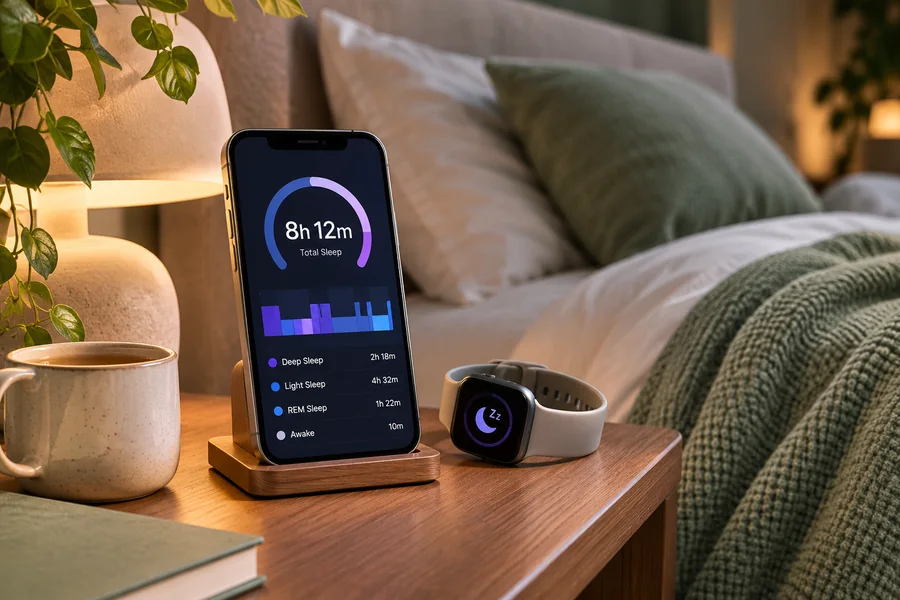
A wrist tracker does not watch your brain sleep. It uses sensor information and an algorithm to estimate what happened overnight. That distinction helps explain why a detailed chart can be useful while still being wrong about individual moments.
Start with the device and version
Check the exact tracker, app version and enabled features. Fitbit products do not all provide identical reports. Software changes can also affect how the same night is classified, so a difference after an update is not necessarily a change in your health.
Signals are not the same as sleep stages
Movement and heart-related signals can help estimate sleep and wake patterns. Clinical sleep assessment uses a different set of measurements. A graph labeled REM or deep sleep should be read as an estimate, rather than a direct recording of brain activity.
Read validation claims carefully
Google publishes research on updated sleep algorithms. Its results concern particular algorithms, devices and study conditions. An average improvement does not guarantee that every night, person or stage will be classified correctly.
Make the record more useful
Wear the tracker according to its instructions and note nights when it was loose, charging or removed. Compare trends with your own account of bedtime, wake time and daytime function. Missing data should remain missing rather than being treated as proof of sleeplessness.
Use the chart to support a conversation
Bring persistent symptoms to a clinician even when the score looks reassuring. Conversely, one low score is not a diagnosis. Read our Fitbit accuracy guide for the difference between detecting sleep and identifying its stages.
Identify what the device measures
A Fitbit uses movement and, on supported models, heart-related signals to estimate sleep and wake periods. Its stage display is an algorithmic estimate, not a direct measurement of brain activity. Check Fitbit's current documentation for the exact model and feature. A device that was not worn securely or lacked battery may have gaps. Note the difference between time in bed and time the app identifies as sleep.
Compare trends under consistent conditions
Use the same device, fit and settings when comparing nights. A late workout, travel or irregular schedule can change both sleep and the available data. Look for a repeated pattern rather than reacting to a single stage percentage. If an app update changes the chart, the scoring method may have changed. Do not treat one color band as proof of a health problem.
Review privacy and next steps
Check where the data is stored, whether you enabled account sharing and what a paid subscription adds to reports. A wearable can prompt a useful conversation, but it cannot diagnose sleep apnea or explain persistent daytime sleepiness. If you have symptoms such as loud snoring, gasping or significant sleepiness, consult a clinician and bring a simple record of what you observed.
Common questions
A little more clarity.
Does a Fitbit directly measure brain waves?
A typical wrist tracker estimates stages from its sensors rather than recording clinical EEG.
Can an app update change my score?
Yes. Check release information and compare like-for-like periods before drawing conclusions.
Does Fitbit measure brain waves?
No. Its consumer sleep stages are estimates from available sensors and algorithms.
Why is one night missing?
Fit, charging, settings or data synchronization may be involved. Check the model's support guidance.
Can a sleep score diagnose a disorder?
No. Discuss persistent symptoms with a qualified clinician.
Should I compare my score with another person's?
The score is not a universal clinical measure. Focus on your own patterns and context.
What should I do if my Fitbit sleep record looks wrong?
Check that the device was charged, worn as the maker directs and synchronized. Review the recorded bedtime and wake time before interpreting the stage chart. A period of quiet wakefulness may be classified as sleep, and a loose fit can affect the available signals. Compare several nights under the same setup rather than drawing a conclusion from one gap. If the app has changed after an update, read the current support information for your model. A persistent health concern should be discussed with a clinician; correcting an app record or buying another tracker will not diagnose the cause of symptoms.