
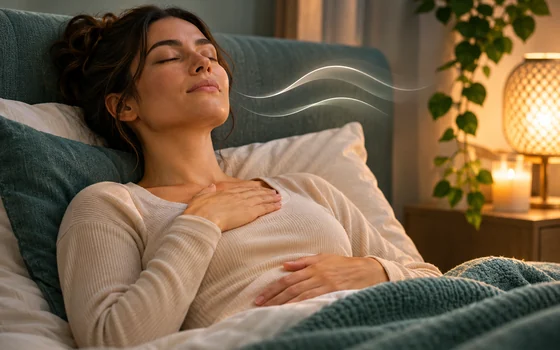
Slow breathing while awake can feel calming, but sleep apnea involves interrupted breathing during sleep. A five-exercise list cannot establish that an airway stays open overnight. Keep prescribed treatment in place while discussing any additional approach.
Start with the diagnosis
Obstructive and central sleep apnea have different mechanisms. A generic breathing exercise does not distinguish them. Use the results of an appropriate assessment to guide care, rather than selecting a treatment from snoring volume or a phone recording.
Separate three different activities
Relaxation breathing, respiratory training and targeted mouth or throat exercises are not the same intervention. Ask which specific approach is being proposed, who supervises it and what outcome it is expected to improve. Evidence for one does not automatically support the others.
Keep established treatment in view
NHLBI describes sleep-apnea treatment options including positive airway pressure and selected alternatives. Do not stop PAP, alter device settings or substitute breath holding because an exercise feels effective while awake. Follow-up testing may be needed to assess treatment.
Avoid restrictive experiments
Do not tape your mouth or intentionally restrict airflow to train yourself during sleep. Stop any exercise that causes dizziness, chest discomfort or breathing difficulty. Ask your clinician whether a supervised adjunct is appropriate for your diagnosis and health circumstances.
Ask for a measurable plan
Useful questions include how progress will be assessed, when follow-up occurs and what to do if symptoms persist. Read our oral appliance guide if a dental option has been suggested. The goal is effective overnight treatment, not mastering a drill.
Do not replace diagnosed treatment
Breathing exercises may be discussed as a supportive activity, but they do not replace prescribed treatment for obstructive or central sleep apnea. NHLBI's treatment overview describes evidence-based options chosen according to diagnosis. Ask your clinician what role, if any, a particular exercise has in your plan. Do not stop PAP, change settings or delay follow-up because a video claims to retrain breathing.
Clarify what an exercise is meant to do
Some programs target upper-airway muscles, while others teach relaxation or breathing awareness. These are not interchangeable, and neither a social-media demonstration nor a before-and-after anecdote establishes the effect on your sleep-study results. Ask what evidence applies to your apnea type, how often the activity should be done and how progress will be assessed. Avoid holding your breath or forcing a pattern that makes you dizzy.
Track symptoms and objective follow-up
Record comfort, adherence to the prescribed treatment and any persistent daytime sleepiness. Ask whether repeat testing or device-data review is needed. Feeling calmer after an exercise is worthwhile but does not prove that breathing events have resolved. Seek medical advice if symptoms worsen or equipment is difficult to use. A clinician can help adjust the broader plan safely.
Common questions
A little more clarity.
Can breathing exercises cure sleep apnea?
A general exercise routine should not be presented as a cure or replacement for prescribed care.
Does quieter snoring prove treatment works?
No. Symptoms and objective assessment need to be interpreted together.
Can exercises cure sleep apnea?
Do not rely on that claim. Discuss any supportive role with the treating clinician.
Should I stop CPAP if I feel better?
No. Discuss treatment changes and objective follow-up with your care team.
Are all apnea types the same?
No. The diagnosis affects which treatments are appropriate.
What if an exercise causes dizziness?
Stop the exercise and ask a qualified professional for advice.
How would I know whether an exercise helped my apnea?
Feeling calmer or breathing more comfortably while awake is not the same as reducing measured breathing events during sleep. Ask the clinician who diagnosed your apnea what outcome would count as improvement and whether follow-up testing or device-data review is planned. Keep using prescribed treatment unless your care team changes the plan. Record sleepiness, snoring reports and any difficulty tolerating therapy, but do not use a smartwatch score as proof that apnea has resolved. The exercise program, if used at all, should have a clearly defined supportive role, safe instructions and a way to discuss lack of progress.