
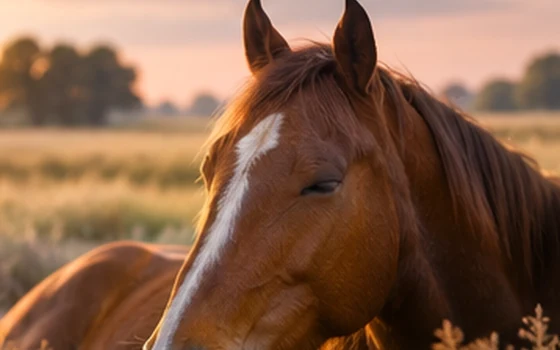
Seeing a horse standing quietly does not tell you everything about its rest. Horses can sleep upright, but they also need opportunities to lie down. The important distinction is between types of sleep, not a claim that horses never use the ground.
Standing sleep has limits
UC Davis equine sleep research describes several sleep states in horses. Upright rest is part of normal behavior, while REM sleep requires a different posture. Avoid using a brief paddock observation as a complete measure of sleep.
Lying down is a normal need
A horse lying comfortably on its side is not automatically in distress. Safety, comfort and the ability to get up matter. The setting should allow the animal to rest without being repeatedly displaced or disturbed, with management appropriate to the individual horse.
Look at access as well as behavior
Consider whether there is a suitable resting area and whether herd dynamics keep a horse away from it. Record changes rather than assuming reluctance to lie down is stubbornness. Pain or physical difficulty can also affect posture and needs professional assessment.
Take buckling or collapse seriously
Rutgers guidance for older horses discusses problems when a horse cannot obtain lying-down sleep. Repeated buckling, injuries or apparent collapse warrants veterinary attention. Do not diagnose narcolepsy from a video or attempt to force the horse down.
Avoid a universal hourly target
Age, environment and health affect the pattern. A horse is not expected to sleep like a human through one uninterrupted block. Share a behavior log with your veterinarian if you are concerned, including when the horse lies down and whether getting up appears difficult.
Separate resting from every sleep stage
Horses can rest while standing, helped by the structure of their legs, but that does not mean they never lie down. Different sleep stages and the need for a safe place to recumbent-rest make the simple yes-or-no answer incomplete. Observe a horse over time rather than using one photograph as proof of its entire sleep pattern.
Consider the herd and environment
A horse may choose a sheltered place where it feels secure, and herd behavior can affect when individuals rest. Bedding, space, footing and health all matter. If a kept horse rarely lies down or appears unusually tired, ask a veterinarian to assess the situation rather than assuming standing rest is enough. A change in posture can also reflect pain or an environmental problem.
Read unusual claims cautiously
A precise nightly sleep total may vary by study and by the animal's conditions. Ask whether the source measured brain activity, posture or simply inactivity. A standing horse with lowered head may be resting, but a lay observer cannot identify every sleep stage. Our animal sleep guide explains why species-specific evidence matters.
Common questions
A little more clarity.
Is a horse lying down always ill?
No. Lying down is part of normal rest, though distress or difficulty rising needs attention.
Can standing rest replace all lying-down sleep?
No. The opportunity to lie down remains important.
Do horses ever lie down to sleep?
Yes. Standing rest does not replace every form of sleep.
Does a standing horse have its eyes closed?
Eye appearance alone cannot identify the exact sleep stage.
Should I worry if my horse never lies down?
Ask a veterinarian to review health, footing and environment if the pattern concerns you.
Can I wake a resting horse for a photo?
Avoid unnecessary disturbance and follow safe handling practices.
What would make a horse's resting pattern concerning?
A change from its usual pattern matters more than an internet hour total. If the horse seems unusually tired, has difficulty getting up, avoids lying down, shows pain or behaves differently in the herd, ask a veterinarian to assess it. Consider the footing, available space, bedding and recent management changes when describing the situation. Do not force the horse to lie down to prove whether it can sleep. Standing rest and lying rest serve different purposes, and a brief observation cannot measure the full sleep cycle. Keep notes about when the change began and any other symptoms so the veterinarian can evaluate the animal in context.