
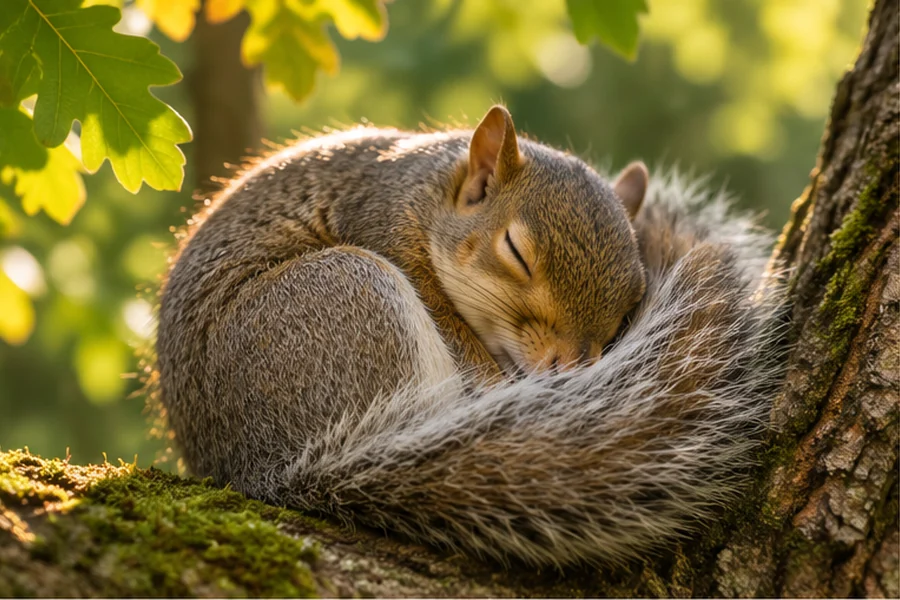
Tree squirrels often use cavities or nests in branches, while ground squirrels may use burrows. That is the starting distinction, not a universal rule. Identifying the kind of squirrel makes the answer more accurate than treating every bushy tail as the same animal.
Tree cavities provide an enclosed resting place
A hollow in a tree can offer shelter without the animal having to build an exposed nest from scratch. Availability depends on the habitat and the species using it.
The Pennsylvania Game Commission's squirrel guide describes several tree-squirrel species and their denning habits. Its details belong to those species, not to every squirrel worldwide.
Leaf-and-stick nests are another option
A rounded bundle high in the branches may be a squirrel nest, often called a drey. It is different from simply lying on an exposed branch for a short rest.
The National Park Service account of Douglas's squirrel describes nighttime use of tree cavities and round leaf-and-stick nests. Look from the ground rather than climbing toward a possible occupied nest.
Ground squirrels can sleep below ground
Burrows provide a different arrangement of shelter. They can include spaces used for nesting, hiding or seasonal dormancy, depending on the species.
Texas Parks and Wildlife describes Mexican ground squirrel burrows used for different purposes. That example explains why a hole in the ground can be relevant to squirrel sleep even when the squirrels you usually notice live in trees.
Day and night activity vary
Many familiar tree squirrels are active during the day, but flying squirrels are commonly active at night. An empty-looking tree in daylight may therefore tell you little about its nighttime occupants.
Observe at an appropriate distance and use a local species guide. The absence of daytime activity is not evidence that the animal has left permanently or needs to be disturbed.
Winter shelter is not always hibernation
Do not equate staying inside during bad weather with true hibernation. Seasonal behavior differs between tree squirrels and the various ground-squirrel species.
When sharing a fact about winter sleep, keep the species and location attached. A statement about one ground squirrel's dormant season should not become a claim that all neighborhood squirrels sleep through winter.
Watch without opening the home
Leave nests and cavities undisturbed. Do not block an entrance because an animal has been quiet for a few hours, and do not handle a squirrel to check whether it is sleeping.
If a nest conflicts with building work or an animal appears injured, contact an appropriate local wildlife professional. Describe what you observed and where, rather than trying to solve the problem by moving the animal yourself.
Identify the squirrel and season
Tree squirrels and ground squirrels do not all use the same shelter. A leaf nest high in a tree, a tree cavity and a burrow serve different species and circumstances. Observe from a distance and note the local species before calling every nest a squirrel bed. Weather, breeding and available habitat can change where an animal rests. A nest visible in winter may not be occupied every night.
Understand what a drey shows
A drey is a leaf-and-twig structure associated with tree squirrels, but its appearance alone does not tell you which squirrel is inside or whether it is currently used. Tree cavities may provide different protection. Do not climb, poke or open a nest to check occupancy, especially when young may be present. If a squirrel has entered a building, consult local wildlife guidance for humane exclusion rather than blocking a potential nursery without assessment.
Keep food and habitat claims modest
A squirrel's daily movements can include several shelter and feeding sites. One backyard sighting is too little to identify its whole sleep routine. Watch at a distance over time and consider how pets, traffic and people affect the location. Our cat rest article illustrates why visible inactivity is not the same as a precise sleep measure across species. For a distressed or injured animal, contact a qualified wildlife rehabilitator.
Common questions
A little more clarity.
Is every large nest in a tree a squirrel nest?
No. Identification needs context. Observe from a distance and consult a local wildlife guide rather than disturbing it.
Do all squirrels sleep at night?
No. Activity patterns differ, with flying squirrels providing a familiar nighttime-active example.
Do all squirrels sleep in trees?
No. Shelter depends on species and habitat; some use burrows.
Is every ball of leaves an occupied nest?
No. Observe from a distance rather than opening it.
Should I move a drey from my yard?
Avoid disturbing a potentially occupied nest. Seek local wildlife advice for a specific problem.
Can squirrels use more than one shelter?
Yes. Do not infer an entire routine from one sighting.