
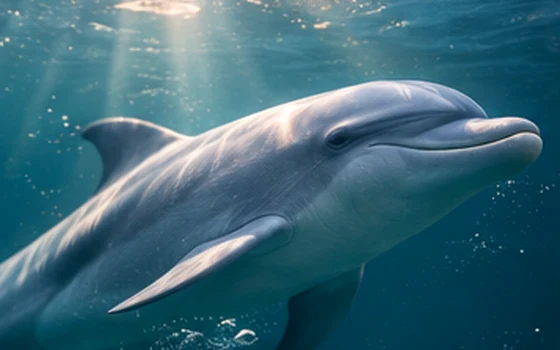
Dolphins can sleep with one brain hemisphere at a time while the other remains more alert. This adaptation helps them maintain activities such as surfacing to breathe. It is a different pattern from the fully still, eyes-closed picture many people associate with sleep.
Understand the term unihemispheric sleep
Unihemispheric means involving one hemisphere, or side, of the brain. In this sleep pattern, the two sides do not enter the same state together. The shorthand half-brain sleep is useful, provided it is not taken to mean the brain is simply switched off.
NOAA Fisheries explains this adaptation in relation to swimming, breathing and awareness in the ocean. It also notes the association with keeping one eye open.
Movement does not rule out rest
A dolphin may continue moving while resting, so human expectations can be misleading. Seeing an animal swimming does not prove that both sides of its brain are in the same waking state.
Equally, a slow-moving animal cannot be diagnosed as asleep from a casual glance. Behavior is one part of the evidence, and species and circumstances matter.
Breathing remains part of the task
Dolphins are air-breathing mammals. They must reach the surface, which makes their situation different from a person sleeping in bed or a fish resting underwater.
This is why the phrase underwater sleep can confuse the issue. The animal still has to manage its surroundings and breathing while obtaining rest. It has not acquired a human ability to remain underwater indefinitely.
Avoid a universal dolphin timetable
Do not assume all dolphin species rest at the same time of day or for the same number of hours. A fact about one studied population should retain that context when it is shared.
For example, guidance about resting spinner dolphins describes a particular conservation concern. It should not be turned into an exact sleep schedule for every bottlenose dolphin.
Give resting animals room
Do not approach, chase or try to wake a dolphin for a better view. A quiet animal is not inviting contact. Follow local wildlife-viewing guidance and the directions of responsible operators.
NOAA's explanation of disturbance to spinner dolphins shows why repeated human interactions can interfere with important behavior. Watching from an appropriate distance is more useful than testing whether an animal reacts.
Understand the observation problem
A dolphin must surface to breathe, so rest is not described accurately by picturing an unresponsive animal on the seabed. Research on cetaceans describes periods when one cerebral hemisphere shows sleep-like activity while the other remains more alert. That does not mean every dolphin behaves identically or that a surface observer can identify brain state from one slow swim. Separate measured sleep from visible rest when reading popular explanations.
Compare behavior in context
A resting dolphin may move slowly, remain near the surface or keep contact with its group. Age, species and environment matter. Captive observations can answer controlled questions but may not represent every wild setting. A photograph of one eye closed is not a complete explanation of the sleep cycle. Ask which species was studied, how long it was observed and whether researchers used physiological measures as well as behavior.
Avoid human sleep analogies
Dolphins do not need to copy a human eight-hour block for their rest to count. Their breathing and social life create different constraints. Our animal sleep overview compares how researchers use behavior and responsiveness across species. If visiting an aquarium or watching wildlife, observe without disturbing an animal to see whether it wakes. A good explanation can describe the measured pattern without claiming that every dolphin sleeps the same way.
Common questions
A little more clarity.
Are dolphins fish that sleep unusually?
No. Dolphins are mammals. Fish have their own varied resting behaviors.
Can people train themselves to sleep like dolphins?
This animal adaptation is not a technique for replacing normal human sleep. It should not be used to justify reducing your sleep opportunity.
Do dolphins stop breathing while asleep?
No. Their need to surface is one reason their rest pattern differs from a human's.
Does one closed eye prove sleep?
Not by itself. Researchers combine behavior with other measurements.
Do all species use an identical schedule?
Do not assume so. Species, age and environment influence observations.
Can I tell from a video?
A video may show reduced activity, but it cannot identify the full physiological state.